均值
均值操作是图像预处理里非常关键的步骤,主要目的是消除图像数据中的偏差,让模型能够更稳定地学习。
原理
在深度学习中,模型训练时使用的图像数据往往会经过预处理,其中均值操作是重要的一环。具体做法是,从图像的每个像素值里减去预先计算好的均值。这样做可以把图像数据的中心调整到零附近,从而加快模型的收敛速度,还能提升模型的稳定性。
使用场景
- 模型训练:在训练深度学习模型时,通常会对训练数据计算均值,然后在训练和推理阶段都进行减去均值的操作,保证数据的一致性。
- 模型推理:在使用预训练模型进行推理时,需要按照模型训练时的预处理方式,对输入图像进行减去均值的操作,这样才能得到准确的结果。
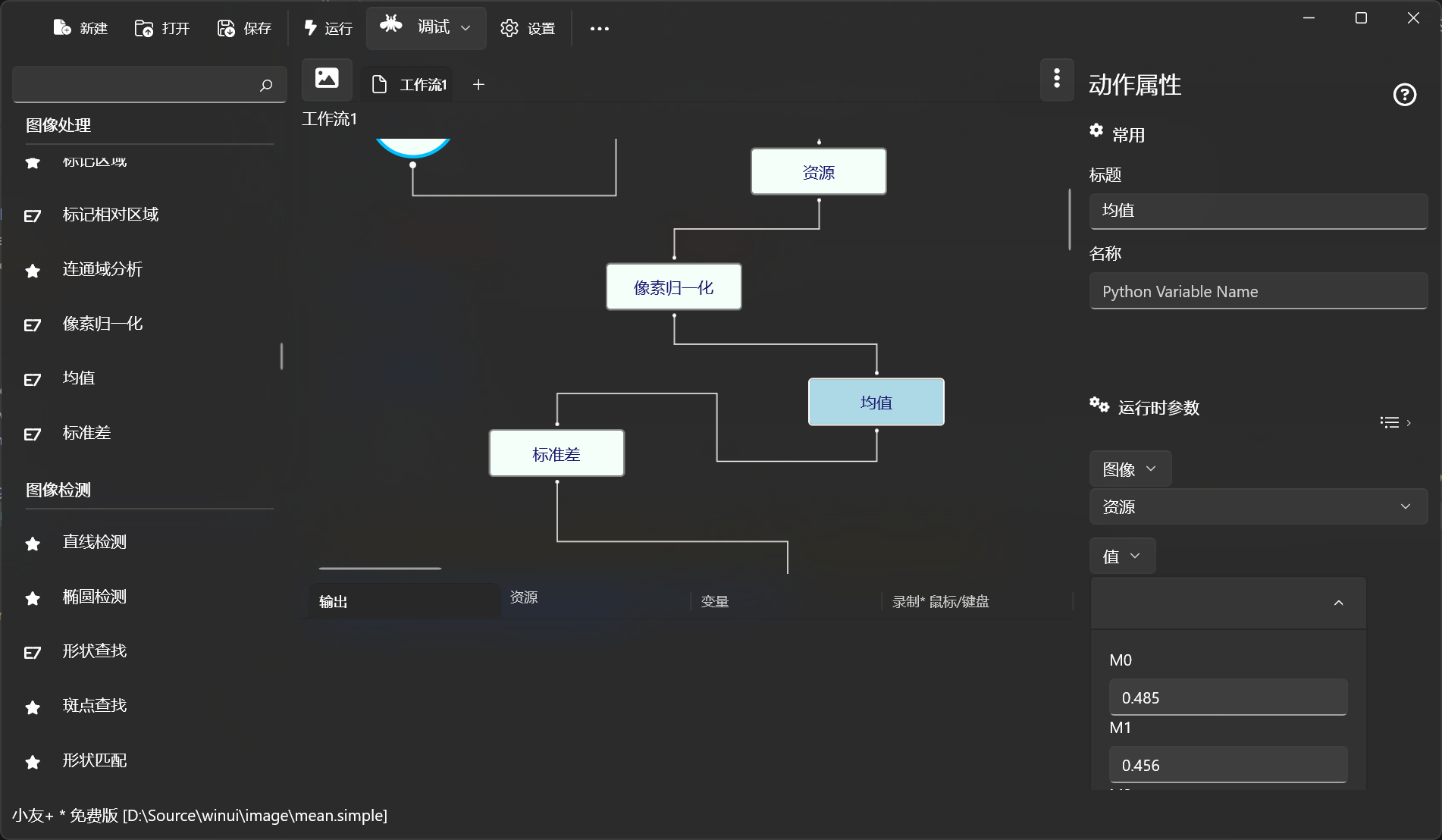
子流程
不支持
运行参数
- 图像
待处理的图像。
- 均值
每个通道的均值,默认(0.485, 0.456, 0.406),对应 RGB 格式的图像。前提是图像像素已缩放至 0~1。如果图像像素没有缩放(图像默认像素范围是 0~255),则使用类似:
(0.485, 0.456, 0.406)* 255 =(123.680,116.779, 103.939)值。
输出
均值后的的图像,参考
Image。
脚本调用
import simple;
资源
!> 如果将默认均值应用到您自己的数据集中,可能不会获得良好的性能,因为这些统计数据属于 ImageNet, 您需要根据不同的预训练的深度学习模型,使用不同的均值。
how to calculate the mean and std in the DataLoader? Here I give two ways:
- Calculate mean and std of the three channels in each batch and average them at the end.
def mean_std_for_loader1(loader: DataLoader):
    mean = torch.zeros(3)
    std = torch.zeros(3)
    for X, _ in loader:
        for d in range(3):
            mean[d] += X[:, d, :, :].mean()
            std[d] += X[:, d, :, :].std()
    mean.div_(len(loader))
    std.div_(len(loader))
    return list(mean.numpy()), list(std.numpy())

means, stds = mean_std_for_loader1(train_dataloader)
print(means)
print(stds)

# Output
# [0.47921667, 0.44638008, 0.40927842]
# [0.26486507, 0.25691825, 0.2580299]
- The std can be derivated from the mean of square of the data and square of the mean of the data, this is referenced from Jorrit Willaert [1]. Here is the formula:
def mean_std_for_loader(loader: DataLoader):
    # var[X] = E[X**2] - E[X]**2
    channels_sum, channels_sqrd_sum, num_batches = 0, 0, 0
    for data, _ in tqdm(loader):
        this_batch_size = data.size()[0]
        weight = this_batch_size / loader.batch_size
        channels_sum += weight*torch.mean(data, dim=[0, 2, 3])
        channels_sqrd_sum += weight*torch.mean(data ** 2, dim=[0, 2, 3])
        num_batches += weight

    mean = channels_sum / num_batches
    std = (channels_sqrd_sum / num_batches - mean ** 2) ** 0.5
    return mean, std

means, stds = mean_std_for_loader(train_dataloader)
print(means)
print(stds)

# Output
# tensor([0.4786, 0.4459, 0.4088])
# tensor([0.2656, 0.2577, 0.2589])